Author Archives: Raj Khatri, PhD

Unknown's avatar

About Raj Khatri, PhD

Land Acknowledgment: I acknowledge that I live and work on the traditional territory of the Mississaugas of the Credit First Nation, as well as the Anishinaabeg, the Chippewa, the Haudenosaunee, and the Wendat peoples. As a treaty person under Treaty 13, I recognize the responsibilities that come with living, learning, and teaching on these lands. My commitment to Indigenous education is grounded in cultural humility, continued learning, and deep respect for Indigenous knowledge systems, languages, and community leadership. About me:  I am an educator and applied linguist specializing in English language development and literacies, with over two decades of experience teaching and mentoring learners and educators across adult, postsecondary, and K–12 contexts in Canada, the United States, and Asia. My work centres on supporting multilingual learners, including international students, newcomers, and students with refugee backgrounds, through inclusive, evidence-informed literacy and language instruction. At George Brown Polytechnic (GBP), where I have served as a full-time permanent professor of ESL-SoTL since 2019 facilitating English for Academic Purposes (EAP), critical literacy, and research skills classes, and where I have contributed to faculty mentorship and scholarship in teaching and learning, I collaborated closely with the Associate Dean and colleagues to spearhead and lead the Scholarship of Teaching and Learning in ESL (SoTL-ESL) initiative in the School of ESL and Immigrant Education from 2019 to 2025. This work, which encompassed Research in ELT, Scholarship in ELT, and a Teaching and Learning Community of Practice in ELT, was both rewarding and professionally enriching. I am grateful for the support and collaboration of the Associate Dean and colleagues in GBP's School of ESL and Immigrant Education. Alongside classroom teaching, I have supervised and mentored pre-service and early-career EAP/ESL instructors, including serving as TESL Practicum Supervising Instructor in the Department of Linguistics at the University of Victoria from 2014 to 2019. I have also taught EAP and literacy-focused courses at Centennial College, the University of Regina, Camosun College, Seneca College, and the Toronto Catholic District School Board. My academic background includes a PhD in Linguistics with a focus on Applied Linguistics from the University of Victoria and a Master of Education from the University of Central Oklahoma. I have received multiple academic awards, grants, and scholarships, including the University of Victoria Fellowship and the Geoffrey & Alix O’Grady Scholarship in Linguistics. My professional preparation also includes Special Education training and extensive continuing education in Universal Design for Learning (UDL), differentiated instruction (DI), literacy instruction, accessibility, and inclusive assessment. My research and professional interests include second-language reading and literacy development, multiliteracies, adult English learners with disabilities, UDL, reflective practice, the SIOP (Sheltered Instruction Observation Protocol) and the Scholarship of Teaching and Learning (SoTL). Committed to service and community engagement, I have volunteered with educational and settlement organizations in Canada and internationally. These activities range from supporting schools in Nepal and working with Plan International Canada in their 'Because I am a Girl' initiative in Nepal to facilitating ESL/EAP classrooms at various settings, including the Toronto District School Board, the Toronto Catholic District School Board, and Regina Public Schools. I have supported voluntary organizations such as the TRIEC, WoodGreen Community Services (Toronto), Regina Food Bank, the Salvation Army (Regina), the Regina Green Patch, and Victoria Immigrant and Refugee Centre Society. I hold an Ontario College of Teachers Certificate of Qualification and Registration (Junior/Intermediate/Senior), a BC Professional Certificate of Qualification (K-12), Saskatchewan Professional ‘A’ Certificate (K–12), TESL Canada (Professional Standard III – Permanent), and TESL Ontario, with long-standing involvement in TESOL International Association. At the core of my work is a belief that strong literacy instruction, inclusive design, and relational teaching practices create meaningful educational pathways and lasting impact for learners and communities. Thank you for visiting! Happy exploring!

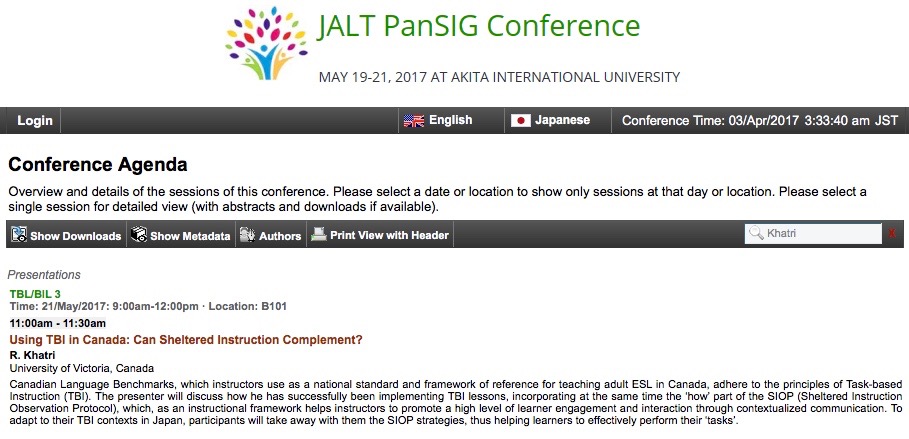
Using Task-based Instruction in Canada: Can Sheltered Instruction Complement? (For presentation at JALT PanSIG 2017)

I would like to invite you to my presentation titled “Using TBI in Canada: Can Sheltered Instruction Complement?,” which is taking place at 11:00 AM on Sunday, May 21 in B101 at Akita International University in Japan.

I will start off the session with a brief introduction of the Canadian Language Benchmarks (CLBs), which is a national standard and framework of reference for teaching adult ESL in Canada and adheres to the principles of TBI among other instructional approaches. We will then discuss its incorporation into adult ESL classrooms, using mainly components and features from the Sheltered Instruction Observation Protocol (SIOP) Model. I believe that there will be some SIOP strategies for you to take away and incorporate in your EFL/JSL and mainstream classrooms in Japanese teaching and learning contexts.

Thank you very much!
Reading Strategy Use among adult EFL Learners in Nepal

Research interest in L2 reading strategy use has been growing considerably among second language practitioners and researchers. Reading strategies are the comprehension processes employed by readers to make sense of what they read (Brantmeier, 2002). As there is a wide consensus among practitioners that the use of a variety of reading strategies can help adult ESL students develop their reading comprehension, the present research investigated adult EFL students’ perceived awareness of reading strategy use in academic context in Nepal. The findings revealed that participants used all three categories of reading strategies at a high- and medium- usage levels. However, no significant differences in overall reading strategy use were found between male and female participants. Significant differences are found between the male and female participants (p < .05) in the means of 3 of the 30 individual reading strategies. Male students’ mean values are significantly higher than female students’ for Global 24 and Problem-solving 25, whereas females’ mean value is significantly higher than males’ for Support 10. Among the other 27 reading strategies, there is no significant difference between male and female students, although female students’ mean values are higher for 17 individual reading strategies and male students’ mean values are higher for 10 individual reading strategies. The overall mean value for all the strategies taken together is higher for female students; however, the difference is not statistically significant. These findings indicated that this particular group of students are aware of a variety of reading strategies. Global strategies are related to reading comprehension (Anderson, 2005). As Global is the least reported category of strategies, the use of Global strategies be encouraged among the readers. It is important that readers’ awareness of appropriate strategies be promoted since when readers are aware of the reading strategies they have already identified, their conscious decision to use appropriate strategies becomes helpful in comprehension of the text (Akkakoson, 2012).